Governed cognitive infrastructure
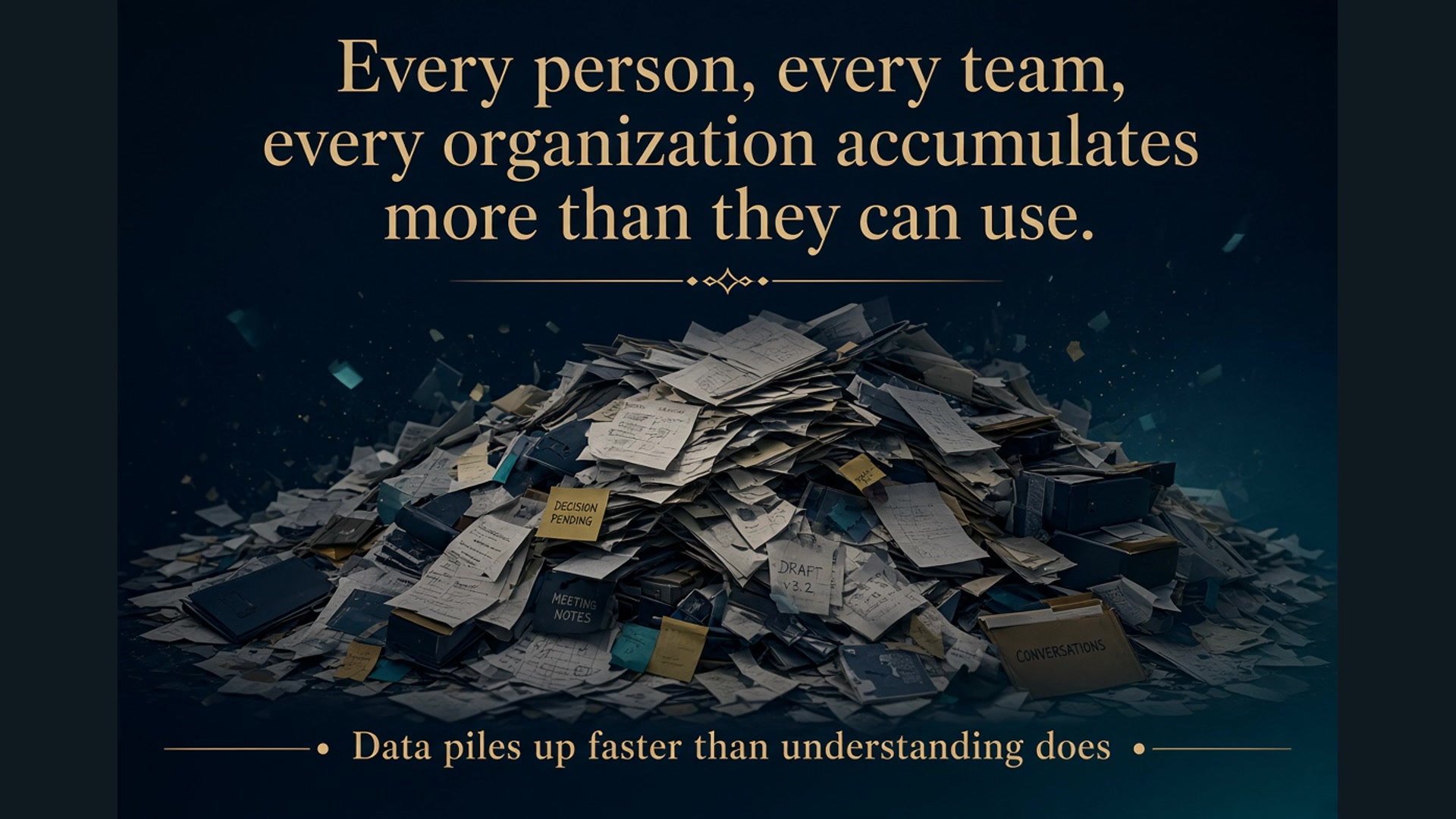
Every organization accumulates more than it can use.
Data accretes more quickly than understanding. CTS is the infrastructure that makes the difference explicit.
What CTS is
A constructed system, not a single layer.
CTS is the constructed cognition system as a whole: an architecture for turning accumulated information into usable, governed knowledge without surrendering human authority.
It separates activities that ordinary information systems blur together — capturing material, deciding what deserves attention, and determining what earns governed standing.
Unqualified CTS always means this umbrella system. It is not an expansion of any one of its domains, and no domain stands for the whole.
Cognition Topology Stack
How cognition is organized
Knowledge boundaries, artifact relationships, layer separation and interface constraints.
Cognition Tool Set
How cognition is executed
Capabilities that operate within the topology. Tools work inside it; they do not define it.
Governance
How the system stays coherent
Authority, metadata, provenance and lifecycle control. Meaning attaches to artifacts, not to tools.
What the three produce together.
When the three domains operate correctly within defined constraints, the result is a Cognitive Operating Environment — the realized environment in which governed knowledge becomes usable.
The direction matters and is normative: CTS constructs the system. The COE is the result. The COE is not a component, a module, or a product, and it cannot be built directly. It emerges from a correctly governed system, or it does not emerge at all.
What CTS is not.
- An application, a product, or a generic collection of tools
- A single repository, vault, service, or interface
- Synonymous with the Cognitive Operating Environment
- Synonymous with any one of its three domains
- A claim that storage alone makes information governed
Demonstration
What the CTS-Lite demonstration shows.
CTS separates stages so that no stage quietly assumes the authority of another. The CTS-Lite demonstration shows that discipline on a small, bounded set of Markdown notes, PDFs and other files, in a disposable test instance.
-
Capture
Each document is recorded with its origin. Its bytes are not changed.
-
Admission
Each document receives one outcome, with the reason recorded.
-
Archive
The admission record is kept in an archive, apart from the Vault copy.
-
Delivery
Each admitted item is delivered into the demonstration Vault.
-
Verification
The Vault copies are checked against the records. Verification writes nothing to the demonstration instance.
Three possible outcomes.
Admitted as itself
A Markdown note enters the Vault with its text unchanged, byte for byte; governed metadata is added under recorded rules.
Described by reference
A PDF is not copied in. The Vault holds a description that refers to the original.
Refused, with a reason
The document is not admitted, and the reason is recorded.
What the checks catch.
- Editing or removing a Vault copy is caught and named. Nothing is repaired automatically.
- Running the same documents again admits nothing twice.
- Resetting the working view leaves the archive untouched; only a full reset of the disposable instance removes it.
Every statement in this section describes the CTS-Lite demonstration, a demonstration implementation, on its disposable test instance. This site describes what the demonstration shows; other CTS components are documented internally and appear here when they are demonstrated.
Who it's for
The same structure, at four scales.
One person
At the smallest scale, CTS may begin with nothing more dramatic than a folder holding years of notes, drafts, diagrams and half-remembered decisions. The value is recovering signal from that accumulation — identifying what still matters and preserving the reasoning behind important work, without pretending every old file deserves permanent attention.
A small team or consultancy
The problem becomes shared continuity. Why was this decision made? Which version is current? What knowledge exists only in one person's head? CTS provides a structure for preserving provenance.
An organization
At scale the same problem expands across policies, procedures, technical records, contracts, repositories and years of accumulated documentation. Much of it is stored but not genuinely controlled. CTS offers a way to distinguish authoritative knowledge from ordinary material.
Anyone deploying AI against their own knowledge
AI raises the value of good knowledge architecture and the cost of bad architecture. A model can search, summarize and synthesize enormous amounts of material, but it cannot repair unclear authority by reading more of it. Feed it chaos and it will summarize the chaos beautifully.
CTS gives a model better boundaries: provenance, explicit standing, and a clear line between evidence, interpretation and authority.
In depth
Component chapters.
Two chapters go further into the parts of CTS the demonstration shows.
One-page overview, to print or share.